Intervals: a beginner’s guide
Learn to describe the distance between notes, then connect the written names to the sounds you hear.
MUSIC GUIDE · NOVEMBER 2, 2026 · ABOUT 7 MINUTES
What is an interval?
An interval is the distance between two notes. Play C, then E: that distance is a third. Play C and E together: it is still a third. Notes one after another form a melodic interval; notes together form a harmonic interval.
First, count the note names
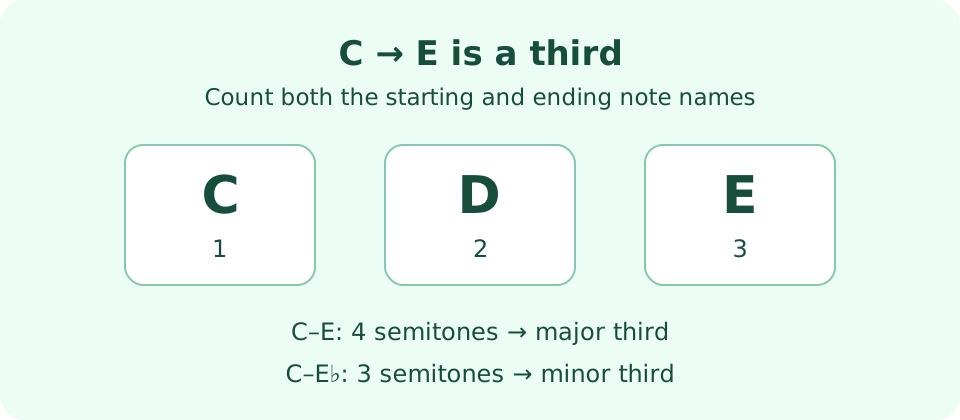
Count both the starting and ending letter. C–D is a second: C(1), D(2). C–E is a third: C(1), D(2), E(3). C–F is a fourth. C up to the next C is an octave: eight letter-name positions.
Sharps and flats do not change that letter count. C–E♭ is still a third because its letters are C and E.
Then, find the quality
The number tells you the letter distance. The quality tells you the precise size. C–E is a major third (four semitones). C–E♭ is a minor third (three semitones). A semitone is the distance from one piano key to its immediate neighbor, counting black and white keys.
Seconds, thirds, sixths and sevenths can be major or minor. Unisons, fourths, fifths and octaves use perfect as their usual quality. Augmented means a semitone larger than the corresponding major or perfect interval; diminished means a semitone smaller than the corresponding minor or perfect interval.
Hear the intervals from C
Each button plays C and then the second note. These examples ascend within one octave.
| Interval | Semitones | Example | Listen |
|---|---|---|---|
| Unison | 0 | C–C | |
| Minor second | 1 | C–D♭ | |
| Major second | 2 | C–D | |
| Minor third | 3 | C–E♭ | |
| Major third | 4 | C–E | |
| Perfect fourth | 5 | C–F | |
| Tritone | 6 | C–F♯ / C–G♭ | |
| Perfect fifth | 7 | C–G | |
| Minor sixth | 8 | C–A♭ | |
| Major sixth | 9 | C–A | |
| Minor seventh | 10 | C–B♭ | |
| Major seventh | 11 | C–B | |
| Octave | 12 | C–C above |
Same piano keys, different written interval
C–F♯ is an augmented fourth: count C, D, E, F. C–G♭ is a diminished fifth: count C, D, E, F, G. Both span six semitones and sound the same on an equal-tempered piano. The spelling matters when reading music. In the listening game, either sound is called a tritone.
Practice with your ears
- Start with major thirds, perfect fifths and octaves.
- Compare two sounds. Replay C–E, then C–E♭. Notice the change without trying to name every pitch.
- Sing the first note, then the second. Listen for direction and distance.
- Add more interval types as the familiar ones become comfortable.
Some people use familiar songs as reminders, but you do not need to memorize song openings or have perfect pitch. The goal is to recognize the relationship between notes.
How melody names work
Do–Re–Mi–Fa–Sol–La–Ti names the seven notes of a major scale. We use movable Do: Do is the tonic, the first note of the key. In C major it is C; in D major it is D. The Ear Training game provides a separate Hear Do button, so you can compare the melody against that reference.
Put it into practice
Use Interval Trainer for written intervals and Ear Training for listening. They exercise related skills in different ways.
Try it, then come back
You do not need to memorize the whole guide. Practice one concept, listen, and return to an example when you get stuck.
Open Ear Training →